
Resin vs filament 3D printer: Compare quality, speed, cost, and strength. Find which is better for miniatures, cosplay, or beginners.
Resin vs Filament 3D Printer: Which One is Right for You?
Introduction
So, you’re thinking about diving into the world of 3D printing. That’s exciting. But if you’ve done any research, you’ve likely come across a big question that stops many beginners in their tracks: should you go with a resin or filament 3D printer? It’s a common dilemma, and you’re definitely not alone in feeling a bit overwhelmed.
Both types of 3D printers have their own strengths and quirks. A resin 3D printer vs filament decision really comes down to what you want to create, how much you’re willing to spend, and how much hands-on work you’re comfortable with. This guide is here to break it all down for you, explaining the differences between these two technologies so you can decide which is better resin or filament 3D printer for your specific needs.
Understanding the Basics: What are Resin and Filament 3D Printers?
Before we get into the nitty-gritty, let’s clear up what we’re actually talking about. The main difference between a resin and filament 3d printer lies in how they build objects and the materials they use.
What is Filament 3D Printing?
First up is the most common type of 3D printer, which uses filament. This process is known as Fused Deposition Modeling (FDM). Think of it as a high-tech hot glue gun. A spool of plastic filament—which looks like a thick string—is fed into a heated nozzle. The nozzle melts the plastic and deposits it layer by layer onto a build plate, slowly building your design from the ground up.
Filament printers are generally user-friendly and are often recommended as the best 3d printer resin or filament for beginners. They are versatile and can be used to create everything from functional household items to large cosplay props. The question of “do all 3d printers use the same filament” is a common one for newcomers. The simple answer is no. While many use standard 1.75mm or 2.85mm filament, the material itself varies, with PLA, ABS, and PETG being the most popular options.
What is Resin 3D Printing?
On the other side, we have resin 3D printing, often called SLA (Stereolithography) or DLP (Digital Light Processing). Instead of melted plastic, this method uses a vat of liquid photopolymer resin. An ultraviolet (UV) light source—like a laser or projector—cures or hardens this liquid resin layer by layer to form a solid object.
If you prioritize detail and a smooth surface finish, resin 3d printing is often the winner. It’s the technology of choice for printing miniatures, jewelry, and dental models. The prints are incredibly precise, with layer lines that are nearly invisible to the naked eye.
Resin vs Filament: A Head-to-Head Comparison
Now that you understand the fundamentals, let’s compare these two technologies across key areas. This resin vs filament 3d printer comparison will help you decide which one fits your projects best.
Printing Precision and Detail Performance
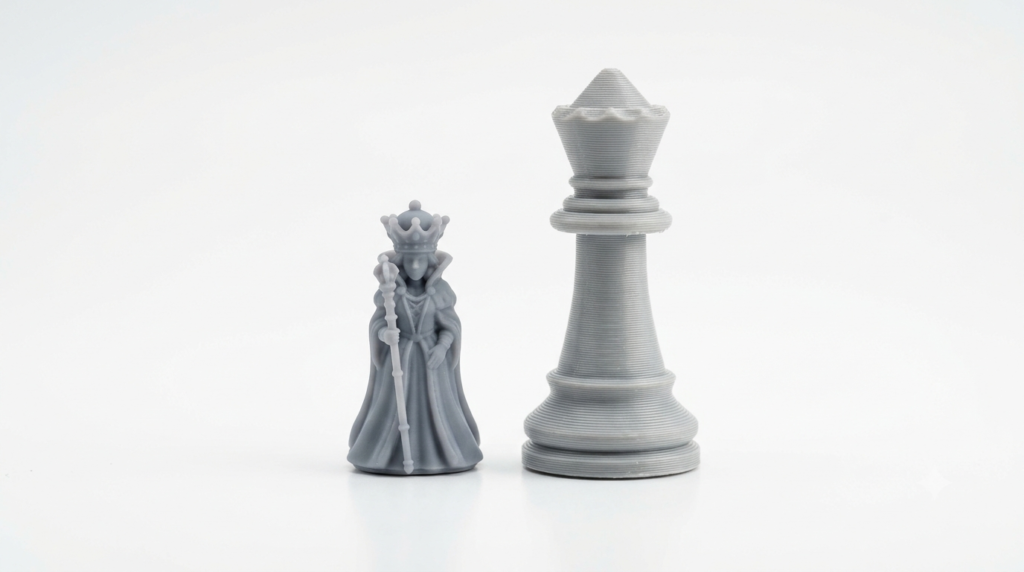
This is where the difference is most striking. If you’re wondering “resin vs filament 3d printer which is better” for detail, resin is the clear winner.
- Resin Printers: They are renowned for their high resolution, typically achieving layer heights of 25 to 50 microns (some can go even smaller). This allows them to capture incredibly fine details, making them perfect for intricate models, tabletop gaming miniatures, and jewelry with sharp edges and smooth surfaces. The result is a smooth surface finish that feels almost like injection-molded plastic.
- Filament Printers: While they are constantly improving, filament 3d models typically have visible layer lines, especially on curved surfaces. The resolution, often between 100 and 400 microns, is limited by the nozzle size. This makes them less suitable for ultra-detailed work, but perfectly adequate for larger, functional parts where microscopic precision isn’t critical.
Material Types and Properties: Strength, Durability, and Cost
When we talk about the “resin vs filament strength” or “resin vs pla strength,” it’s important to consider the different types of materials available for each.
- Filament Materials and Strength: Filament offers a wide variety of materials, each with different properties. PLA is biodegradable, easy to print, and cheap. ABS and PETG are tougher and more durable, making them suitable for parts that need to withstand stress or heat. You can even find specialized filaments like carbon-fiber-infused or flexible TPU. Because of these options, filament prints are generally stronger and more impact-resistant than standard resin prints. If you’re asking “what is stronger resin or filament 3d printer,” the answer is often filament, especially when using materials like ABS or PETG.
- Resin Materials and Properties: Resin prints are notoriously brittle and can shatter if dropped. However, the market has expanded with engineering-grade and tough resins that offer greater durability and flexibility, though at a higher cost. For most hobbyists, standard resin is best for visual models, not functional parts that will be handled roughly. A common question is “are resin prints stronger than pla” or “is resin stronger than pla,” and generally, standard PLA is more impact-resistant than standard resin.
Cost Analysis: Initial Investment and Ongoing Expenses
Budget is a huge factor for most people, and the “resin vs filament price” and “cost of resin vs filament” are significant differences.
- Initial Costs: Entry-level printers for both types are more affordable than ever. You can find decent filament 3d printers and resin 3d printers in a similar price range, often between $200 and $500.
- Material Costs: This is where a big difference lies. Filament, especially PLA, is cheaper, with a 1kg spool costing around $15–$25. Resin is more expensive, typically $30–$50 per liter, and can go much higher for specialized types. So, when considering “resin or filament 3d printer better” on a budget, filament wins. The “resin vs filament cost” comparison is a major point for many users.
- Ongoing and Hidden Costs: Resin printing requires additional, non-optional costs. You’ll need isopropyl alcohol (IPA) for washing prints, gloves for safety, and a UV curing station or sunlight for post-curing. FEP film, the clear plastic at the bottom of the resin vat, also needs periodic replacement. Filament printing has fewer hidden costs, though you may occasionally need to replace a nozzle or use adhesives on the build plate.
Ease of Use: Setup, Safety, and Post-Processing
The question of “resin vs filament 3d printer for beginners” often comes down to ease of use. In this category, filament printers are generally more straightforward.
- Filament Printers: They are often considered plug-and-play, requiring minimal setup. Maintenance, while necessary (like bed leveling and nozzle cleaning), is relatively simple. They are also much safer to use indoors, with PLA being a low-odor, non-toxic material.
- Resin Printers: These have a steeper learning curve. The process is messier, involving handling liquid resin which is toxic and requires you to wear gloves and work in a well-ventilated area. Post-processing is a must: prints need to be washed in a solvent like IPA and then cured under UV light to reach their full strength. This adds significant time and effort to the overall workflow, making “resin vs filament 3d printer speed” a tricky question, as resin might print the part faster but the total project time can be much longer.
Build Volume: How Big Can You Go?
Size matters, especially if you plan on printing large objects.
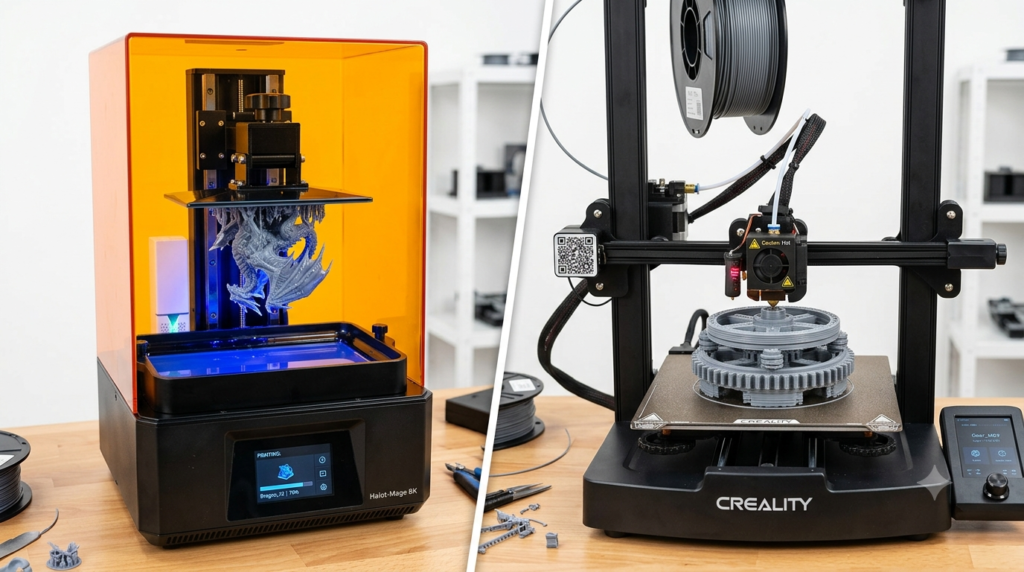
- Filament Printers: They typically offer much larger build volumes, making them the go-to choice for big projects like cosplay helmets, large prototypes, and functional home goods.
- Resin Printers: They generally have a smaller build area, which limits the maximum size of your prints. While you can print many small items at once, you won’t be able to print a full-size helmet in one go on most resin printers.
Which One Should You Choose?
So, after all that, “which is better resin or filament 3d printer” or “resin or filament 3d printer better” ? The honest answer is: it depends on you. There is no single “better” choice, only what’s better for your specific projects.
Who Should Choose a Filament Printer?
- You want to create large, functional parts like brackets, tool holders, or cosplay accessories.
- You’re on a budget and want the most value for your money in terms of materials and printer cost.
- You prefer a simpler, safer, and less messy experience, especially if you’re a beginner.
- You’re interested in educational models, prototypes, or household items.
- You want to work with a wide variety of materials, including flexible or high-strength options.
Who Should Choose a Resin Printer?
- You need ultra-high detail and a glass-smooth surface finish for items like tabletop miniatures, jewelry, or dental models.
- You’re an artist, jeweler, or model maker who prioritizes precision over size.
- You don’t mind the extra work and safety precautions involved in post-processing and handling toxic materials.
- Your prints are primarily for display or visual purposes rather than heavy-duty, functional use (unless you invest in expensive engineering resins).
- The project is small enough to fit within the printer’s build volume.
Frequently Asked Questions
Is resin 3D printing better than filament?
It depends on your needs. Resin printing is better for detail and smooth finishes, making it ideal for miniatures and jewelry. Filament printing is better for strength, durability, and large functional parts.
Is resin or filament better for 3D printing?
For large, functional, and cost-effective parts, filament is better. For highly detailed, visually stunning objects, resin is the superior choice.
Is a resin or filament 3D printer better?
A filament printer is generally better for beginners and for making strong, large items. A resin printer is better if your top priority is print quality and detail over everything else.
Is a resin 3D printer better than filament?
A resin printer is better for precision, detail, and surface finish. However, it is not better for strength, build size, ease of use, or ongoing costs.
What is the difference between resin and filament 3D printers?
The main difference is in the material and process. Resin printers use a liquid resin that is cured by UV light, resulting in highly detailed prints. Filament printers (FDM) use a melted plastic filament that is extruded and layered, creating stronger, larger, and more functional parts. The question of “what the difference between filament and resin 3d printer” is fundamental to making the right choice.
Which is faster resin or filament 3D printer?
It’s not a straightforward answer. Resin printers can be faster for small, highly detailed parts because they cure an entire layer at once. Filament printers can be faster for larger objects due to faster movement speeds and thicker layers. However, the total time for a resin print includes lengthy post-processing (washing and curing), which can make the overall project take longer than a filament print that is ready to use after support removal.
Is resin or filament stronger?
Generally, filament is stronger and more impact-resistant, especially when using materials like ABS, PETG, or nylon. Standard resin is brittle and prone to breaking under stress, though specialized tough resins are available.

